

ZHAW – Electrochemical Cells & Energy Systems
The Zurich University of Applied Sciences is one of the largest and leading universities of applied sciences in Switzerland. Within the School of Engineering, the Institute of Computational Physics (ICP) brings together a team of approximately 60 physicists, mathematicians and engineers who apply methods and results from fundamental research to industrial problem areas. For over 20 years, the ICP has been developing multiphysics computer models and customized numerical software in close collaboration with research and industry partners.
The Electrochemical Cells & Energy Systems group specializes in the development of physics-based models and simulation software for electrochemical flow cells. Our target applications include redox flow batteries, electrolyzers, PEM fuel cells, CO2 reduction, and electrosynthesis. We develop scale-specific and multi-scale models ranging from electrochemical double-layer models, through pore-scale resolved porous electrode models, up to macrohomogeneous cell-scale models describing coupled multiphysics phenomena for performance and degradation predictions.
We are offering specialized modelling and simulation services and collaborations in the following areas:
- Physics-based modelling and simulation of electrochemical flow cells
- Microstructure characterization and effective transport property prediction
- Model-based analysis and design of electrode structures
- Consulting on cell design and performance optimization
- Custom model development for performance or degradation simulations
Prof. Dr. Jürgen Schumacher
Technikumstrasse 71
8400 Winterthur
+41 58 934 69 89
juergen.schumacher@zhaw.ch
Website
Dr. Roman P. Schärer
Technikumstrasse 71
8400 Winterthur
+41 58 934 79 39
romanpascal.schaerer@zhaw.ch
Website
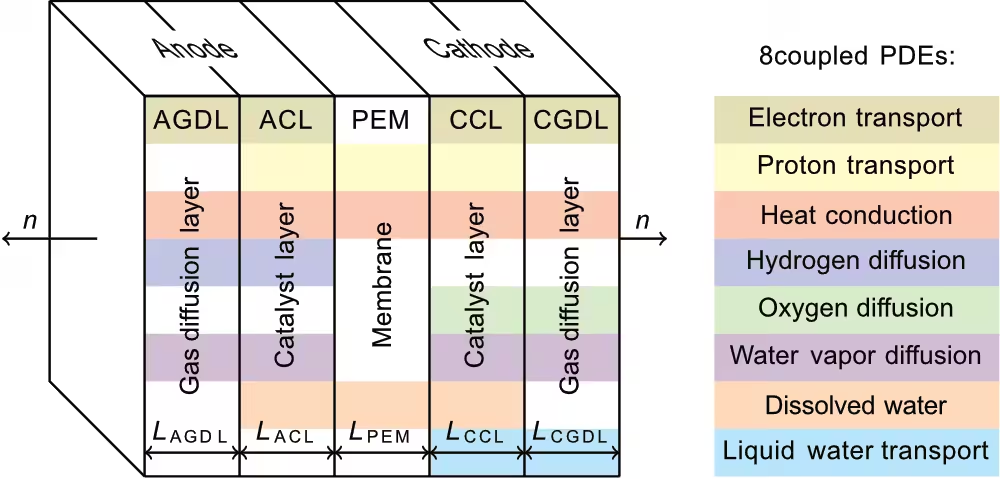
Macro-homogeneous model of a PEM fuel cell MEA with multi-physics coupling
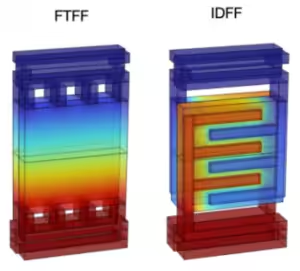
Pressure distribution within 3D-resolved redox flow battery cells
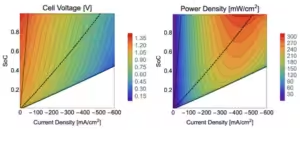
Cell voltage and power density predictions of a lab-sized flow battery cell
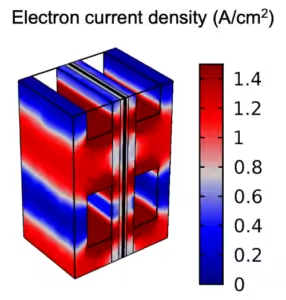
Simplified porous electrode structures for the evaluation of effective transport properties
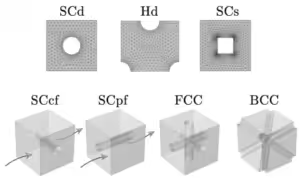
Simplified porous electrode structures for the evaluation of effective transport properties
